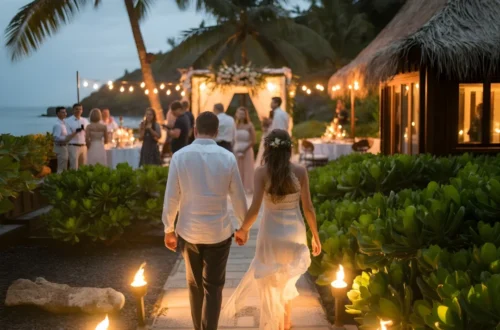

Planning a honeymoon usually starts with one big question: should we do an all-inclusive resort, or plan the trip ourselves? Both sound appealing, and both come with trade-offs that aren’t always obvious at first.
An all-inclusive honeymoon promises ease. Meals are handled, schedules are light, and once you arrive, there’s very little to think about. A DIY honeymoon offers more freedom — different hotels, local food, and the chance to shape the trip exactly how you want it — but it also requires more planning and decision-making.
This guide breaks down how all-inclusive and DIY honeymoons actually compare, from costs and planning time to how each one feels once you’re there. The goal isn’t to tell you which option is “better,” but to help you figure out which style makes the most sense for the kind of trip you want after the wedding.
What an All-Inclusive Honeymoon Really Looks Like
An all-inclusive honeymoon usually means staying at one resort where most of your day-to-day costs are bundled into the upfront price. Once you arrive, there’s very little to plan. Meals, drinks, and basic activities are already taken care of, and the focus is on relaxing rather than organizing.
That said, “all-inclusive” doesn’t always mean everything is included.
✅ What’s Typically Included
❌ What’s Usually Extra
- Your room or suite
- All meals at on-site restaurants
- Drinks, including alcohol (with some limits)
- Pools, beach access, and resort facilities
- Basic activities like kayaking, yoga, or entertainment
For many couples, this simplicity is the biggest appeal. After months of wedding planning, not having to make constant decisions can feel like a relief.
- Spa treatments
- Extra or Off-resort excursions
- Private tours or experiences
- Premium dining options or top-shelf alcohol
- Gratuities at some resorts
- Transport (depending on the resort)
These add-ons can increase the total cost, which surprises some couples who expect the price to be completely final.
How It Feels Once You’re There
All-inclusive honeymoons tend to feel calm and predictable. Days are unstructured, meals don’t normally require reservations, and it’s easy to fully switch off. The trade-off is that you’re mostly staying in one place, and your experience is centered around the resort rather than the destination as a whole.
For couples who want a low-stress, easy reset after the wedding, that can be exactly the point.
What a DIY Honeymoon Really Looks Like
A DIY honeymoon means planning the trip yourself rather than staying in one all-inclusive resort. You’re choosing the flights, hotels, transportation, and daily plans, whether that’s booking a table at a local restaurant or deciding where to go next.
This doesn’t mean your honeymoon has to feel complicated or rushed — but it does mean you’re more involved in shaping how the trip unfolds.
📝 What DIY Planning Usually Involves
✅ Where DIY Honeymoons Work Best
- Booking flights and accommodations separately (some All-Inclusives may or may not include flights)
- Choosing where to stay (one hotel or multiple stops)
- Deciding where and what to eat
- Planning activities, tours, and day trips
- Managing transportation between places
Some couples enjoy this part of the process, especially if travel planning feels exciting rather than stressful.
DIY honeymoons shine in destinations where exploring is part of the experience, such as:
- Cities with great food, culture, and walkability
- Regions where moving between towns is easy
- Places where you want variety rather than staying in one spot
Instead of one base, you might split your time between a few locations or mix slower days with more active ones.
How It Feels Once You’re There
DIY honeymoons often feel more immersive and personal. You’re experiencing the destination beyond a single property, discovering favorite cafés, neighborhoods, or views along the way. Each day can feel different, which keeps the trip engaging.
The downside is that decision-making doesn’t stop once you arrive. Choosing where to eat or what to do can be fun — or tiring — depending on your energy level after the wedding.
For couples who like flexibility, variety, and a sense of exploration, a DIY honeymoon can feel more meaningful than a fully packaged stay.

At the end of the day, there’s no official leaderboard for honeymooning—you don’t get extra points for planning every detail yourself, nor is there a trophy for finishing the resort’s entire drink menu.
Cost Comparison: All-Inclusive vs DIY Honeymoon
Cost is often the deciding factor, but it’s also where expectations can get fuzzy. For 2025–2026, the typical honeymoon cost is roughly $5,000+, but how that money is spent varies significantly between an All-Inclusive resort and a Do-It-Yourself (DIY) trip.
While All-Inclusive used to be the “luxury” choice, current travel trends for 2025/2026 show that all-inclusive packages are often cheaper than DIY trips of the same caliber, primarily because food and alcohol inflation has hit standalone restaurants harder than large resorts.
7-Day Comparison: Cancun/Caribbean (Typical Mid-Range)
|
Expense Category
|
All-Inclusive Resort
|
DIY (Hotel + Dining Out)
|
|---|---|---|
|
Flights (Round Trip)
|
$800
|
$800
|
|
Accommodation
|
$3,050 ($435/nt)
|
$1,575 ($225/nt)
|
|
Food & Snacks
|
Included
|
$1,120 ($80/person/day)
|
|
Alcohol & Drinks
|
Included
|
$700 ($50/person/day)
|
|
Airport Transfers
|
Often Included
|
$100 (Taxi/Uber)
|
|
Activities/Tips
|
$300 (Excursions/Extra tips)
|
$300 (Tours/Tips)
|
|
Total Estimated
|
$4,150
|
$4,595
|
Note; *Based on 2025 pricing for a 4-star experience for two people.
How These Figures Were Calculated
- These estimates are based on aggregated travel industry data for 2025, including pricing benchmarks from major booking platforms and annual wedding trend reports from sources like The Knot and Zola. The “mid-range” profile assumes a 4-star experience during a standard travel season; however, please note that actual costs fluctuate significantly based on your specific travel dates, how far in advance you book, and your chosen destination’s local economy.
DIY trips can be more budget-friendly or more expensive than all-inclusives, depending on how much you move around and how often you splurge. You can go to a fast food for dinner one night and a Michellin-star restaurant next. That’s the flexibility of DIY honeymoon which you may or may not like.
Decision Matrix: Which Option is right for you?
Think of this matrix as a quick “vibe check” for your post-wedding sanity. It really boils down to whether you want your only difficult decision to be “pool or beach” 🏖️ (Team All-Inclusive), or if you’re ready to trade the resort buffet for a “choose-your-own-adventure” hunt for the world’s best hidden taco stand 🌮 (Team DIY).
|
Choose All-Inclusive if...
|
Choose Do-It-Yourself if...
|
|---|---|
|
You just finished planning a stressful wedding and want zero decisions.
|
You want to eat at authentic local spots rather than resort buffets.
|
|
You want a predictable budget with no surprises at checkout.
|
You have travel points/miles to use for hotels or flights.
|
|
You plan to spend 80% of your time on the resort grounds.
|
You plan to be out exploring/hiking most of the day.
|
|
You enjoy cocktails, wine, or beer throughout the day.
|
You are traveling to Europe or Southeast Asia (where AI is rare or poor value).
|
Planning Time & Stress: How Much Work Each Option Really Takes
After the wedding, most couples are more tired than they expect. That’s why planning effort matters just as much as budget or destination.
Some well traveled couples enjoy the planning part, while others may find it stressful.

🏩 All-Inclusive Honeymoon Planning
📝 DIY Honeymoon Planning
All-inclusive honeymoons require very little upfront planning. Once you choose the resort and dates, most of the details are already handled.
Before the trip, planning usually involves:
- Booking the resort (and flights, if not included)
- Choosing a room category
- Deciding whether to add any excursions or spa treatments
Once you arrive, daily decisions are minimal. Meals don’t need reservations, transportation is usually arranged, and activities are optional rather than scheduled. For many couples, this ease is the main benefit.
DIY honeymoons involve more work before you leave, and a bit more thinking while you’re there.
Planning typically includes:
- Booking flights and accommodations
- Deciding where to stay and for how long
- Researching neighborhoods, restaurants, and activities
- Coordinating transportation between stops
On the trip itself, you’re still making choices — where to eat, what to see, and how to get around. Some couples enjoy this flexibility, while others find it tiring, especially right after the wedding.
How to Think About Stress
Neither option is right or wrong. The key question is how much mental energy you want to spend on your honeymoon.
If the idea of making decisions feels draining, an all-inclusive setup can feel like a reset. If exploring and choosing as you go sounds exciting rather than stressful, a DIY honeymoon may suit you better.
The Hybrid Option: A Balance Between Relaxing and Exploring
For many couples, choosing between all-inclusive and DIY isn’t an either-or decision. A hybrid honeymoon combines elements of both, and it’s often the option couples are happiest with in hindsight.
A common approach is to split the trip into two parts. You might start with a few nights at an all-inclusive resort to unwind after the wedding, then move on to a city or region where you can explore at your own pace. Others do the reverse, ending the trip at a resort so they can relax before heading home.
 You may be interested in reading more about “Honeymoon Hotel Hopping”
- All Posts
- Asia
- Blog
- C. America
- Caribbean
- Europe
- N. America
- Nature
- News
- Oceania
- Paris
- Rome
- S. America

Imagine arriving in a new city and checking into a hotel that feels like a dream — but then, halfway...
What to Keep in Mind
Hybrid trips work best when you limit how many times you move locations. Two stops is usually enough. More than that can add unnecessary stress, especially on a honeymoon.
This option works particularly well for longer trips, where staying in one place the entire time might feel limiting, but a fully packed itinerary would be exhausting.
Final Thoughts
All-inclusive and DIY honeymoons can both be great — the difference is how much planning and decision-making you want during the trip. An all-inclusive works best if rest and simplicity are the priority, while a DIY honeymoon suits couples who enjoy exploring and flexibility.
Choose the option that feels easiest to enjoy, not the one that sounds most impressive.